By Nima Sabouri
1. Review of Two News Reports:
According to a report by the Mizan News Agency, affiliated with the Iranian Judiciary, the death sentences of Hassan Divband, Hamid Kazemi, and Reza Zanganeh, three individuals detained during the January 2026 protests in Karaj, were carried out on the morning of Sunday, November 8, 2026.
According to this state-run news outlet, the three men had been sentenced to death and asset forfeiture on charges of “operational cooperation with Israel and the United States and armed participation in the protests of January 8 and 9, including the destruction and arson of public places and power installations,” with their assets currently being confiscated.
Just one day earlier, on November 7, 2026, the Iranian Judiciary labeled the report by Mai Sato (the UN Special Rapporteur on the situation of human rights in the Islamic Republic of Iran) as “biased.” The Judiciary’s Deputy for International Affairs and Secretary of its “High Council for Human Rights” described Ms. Sato’s recent report as “unsubstantiated, partisan, and politically motivated.”
2. Analysis:
We do not even need to conduct extensive research to understand the catastrophic contradictions that shape the political sphere, or the sphere of life and death, in contemporary Iran—unfortunately, the dimensions of these issues are terrifyingly vast and correspondingly evident. It suffices to follow the headlines of a state news agency over two consecutive days (sometimes even within a single day) to see how the state itself loudly proclaims the depth of these contradictions in bold text.
Of course, we should not assume that in such instances an error occurred due to human oversight or an unintentional overlap of public and confidential information. On the contrary, this kind of state denial of truth is itself a strategic approach in contemporary governance. It is a dual strategy: on the one hand, it extends the key lessons of “information warfare,” especially in confrontation with “foreign enemies,” to shape perceptions in global (and domestic) arenas; on the other hand, through an imperious display of the state’s capacity to deny and redefine “truth,” it mocks the cognitive capacity and agency of the oppressed to comprehend and reconstruct the reality of oppressive relations. In this regard, there is little difference among the representational mechanisms of the Trump administration, the Netanyahu government, or the power system of the absent leader of Iran.
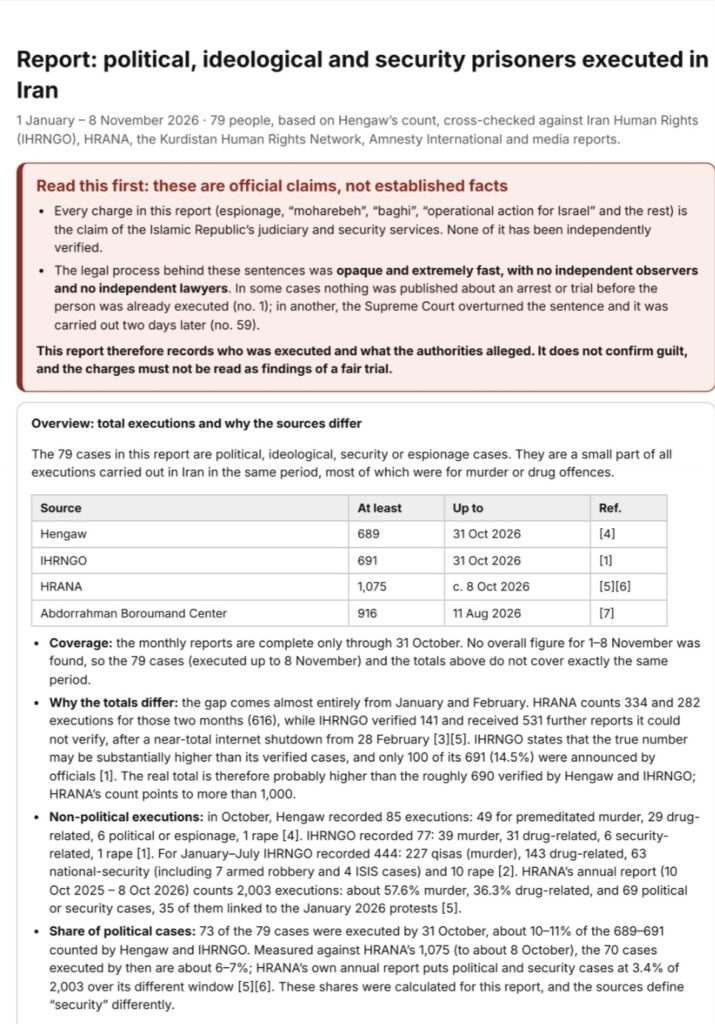
Regarding the Iranian state, as far as state-sanctioned killings through “legal executions” are concerned, the issue is not merely scaring the broad masses of the hungry, the dissatisfied, and the opposition through a display of brutal state power. Rather, another facet of this intimidation is directed at humiliating, denying, and destroying the perceptual capacity and cognitive agency of the oppressed—an epistemological poison that is continuously produced and multiplied. [Editor’s Note: See the information at the end of this article, summarized by Roud Collective, for a glimpse into the horrific scale of state executions in Iran].
In fact, the daily execution of prisoners in Iran and the rising execution of political prisoners (protesters/opponents of the dominant political system) could not achieve the desired outcomes for the rulers of the Islamic Republic on their own if the state’s mode of representing these executions did not also cover this cognitive dimension of intimidation.
One might, however, ask: upon what historical bedrock has such shamelessness been made possible? I believe the answer must be sought in the metamorphosis of imperialist relations, driven by the intensification of global crises of capitalism. Parallel to the deepening of pervasive global crises, a distinct consequence of this metamorphosis is the escalation of imperialist conflicts and inter-state hostilities based on a binary framing of good versus evil. Yet, across the field of actors in this arena, nothing can be observed except evil states (setting aside the general proposition that the state is inherently evil).
The process unfolds as follows: In an era where the furtherance of imperialist relations is increasingly manifested in conflicts between evil states, reducing the domain of politics exclusively to clashes among evil actors and glorifying these conflicts as heroic ones (from any side) ultimately justifies evil itself in practice and normalizes shamelessness. The Iranian state can deny and justify its crimes simply by pointing to the evil nature of its foreign rivals. Along this path, not only is the exercise of domination accompanied by broader military violence, but the expansion of this violence is sanctified as part of a global-historical (or theological) mission. Consequently, any alternative beyond the dominant anti-human order is more easily denied or rendered increasingly unimaginable. The severe ramifications of this global condition can be observed in Sudan, Palestine, Afghanistan, Iran, and many other places.
The immediate consequence of this situation in Iran today is that the Islamic Republic of Iran has easily been able to hold lives hostage to prolong the monopolized power-wealth apparatus of its rulers. In short, the intensifying entanglements and alignments between imperialist and despotic relations in our era have enabled the expansion of the governance of evil through extended forms of necropolitics in Iran.
#NoToExecution
#StruggleForLife
#KinshipOfDespotismAndImperialism
Source:
Roud Collective (November 2026). “Political, ideological and security-related executions in Iran, 1 January – 8November 2026: A documented overview of 79 cases, based on human rightssources”. Iran Report. You can follow Roud Collective on Instagram @roudcollective.global